
- Home
- »
- Display Technologies
- »
-
Flexible Substrates Market Size, Share Report 2026-2033GVR Report cover
![Flexible Substrates Market (2026 - 2033)Report]()
Flexible Substrates Market (2026 - 2033)
Size, Share, & Trends Analysis Report, By Material (Plastic, Metal, Glass), By Type (Plastic, Metal, Glass), By Application (Flexible Displays,Solar Cells, Sensors), By End Use, By Region, And Segment Forecasts
Market Size, 2025
$3.5BMarket Estimate, 2026
$3.9BMarket Forecast, 2033
$8.2BCAGR, 2026–2033
11.4%Flexible Substrates Market Summary
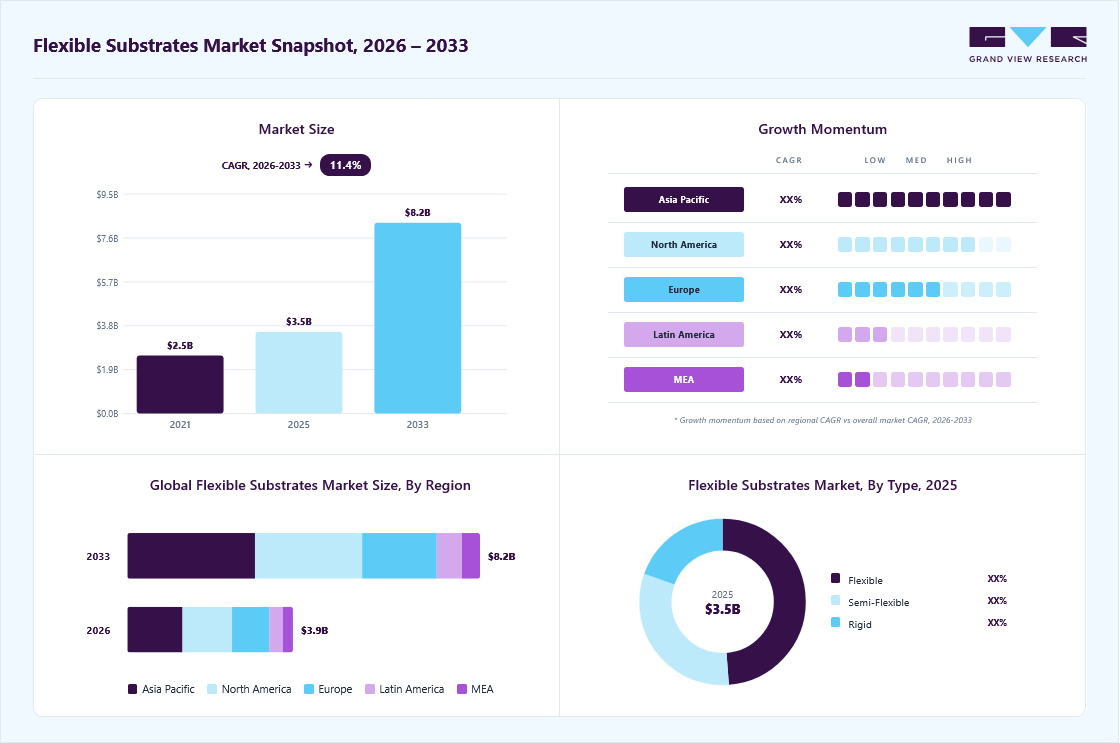
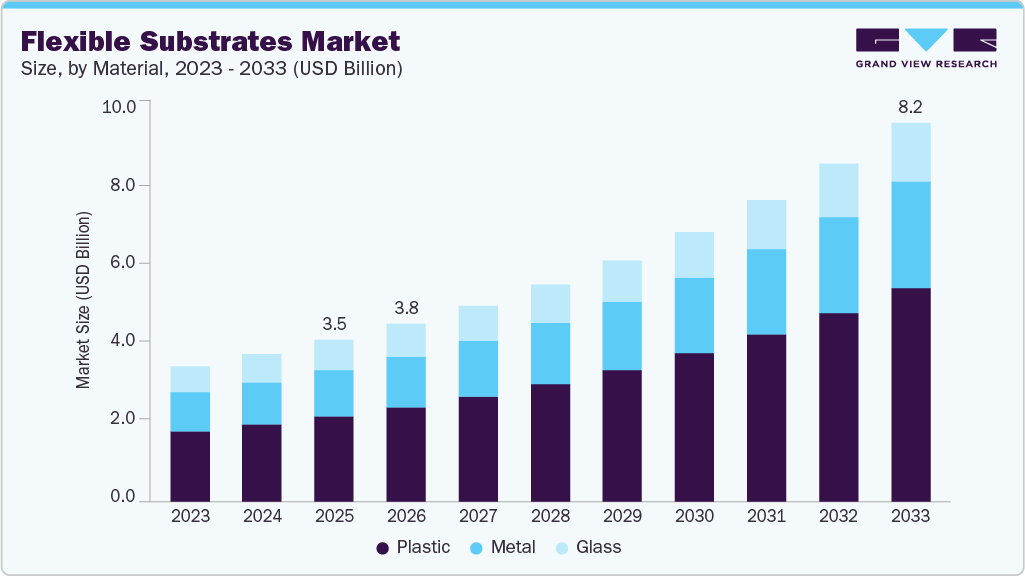
The global flexible substrates market size was valued at USD 3.5 billion in 2025 and is projected to grow from USD 3.9 billion in 2026 to USD 8.2 billion by 2033, at a CAGR of 11.4% from 2026 to 2033. The Asia Pacific held the largest share of 32.9% of the global market in 2025. The rapid growth of flexible electronics across industries such as consumer electronics, healthcare, and automotive is driving the market.
Key Market Trends & Insights
- By material: Plastic segment held the largest share of 52.9% in 2025.
- By type: Flexible segment held the largest revenue share in 2025.
- By application: Flexible displays segment held the largest share in 2025.
Regional Highlights
- Largest regional market: Asia Pacific (32.9% revenue share, 2025)
- By country: The China led the Asia Pacific market in 2025.
Market Size & Forecast
- Market size in 2025: USD 3.5 Billion
- Estimated market size in 2026: USD 3.9 Billion
- Projected market size by 2033: USD 8.2 Billion
- CAGR (2026-2033): 11.4%
Three ways to get this report
Buy it, customize it, or ask a question.Ask an Analyst
A direct answer, usually in 1 working day
- AccessReport author, directly
- Reply timeWithin 1 working day
- No sales callDirect answer only
- FormatEmail reply
- CostFree, no cost
Get the Full Report
What the study covers
- FormatsPDF · Excel · Dashboard
- Timeline2026–2033 annual, 2025 base
- Coverage20+ countries, 5 regions
- Companies10+ key players profiled
Customize the Report
20% free customization
- IncludeCountries, segments, points
- TailorTo your product definition
- ExtendDeeper competitor detail
- OrA fully bespoke study
- Turnaround5–10 working days
The growing adoption of wearable technology and healthcare monitoring devices is also a key driver of the flexible substrates market. Wearable devices such as fitness trackers, smartwatches, and medical sensors require materials that can conform to the human body. Flexible substrate enables the development of skin-like electronics that can bend and stretch without losing functionality. This is particularly important for continuous health-monitoring applications, where comfort and durability are essential. Additionally, flexible substrate supports the integration of sensors and circuits into textiles and medical patches. As the healthcare industry increasingly adopts digital and wearable solutions, the demand for flexible substrates is rising.Another important driver is the expansion of the automotive industry and the increasing integration of advanced electronics in vehicles. Modern vehicles are equipped with a wide range of electronic systems, including infotainment displays, sensors, and advanced driver assistance systems. Flexible substrates are used in curved displays, lighting systems, and electronic control units to improve design flexibility and space utilization. They also contribute to weight reduction, enhancing fuel efficiency, and supporting the transition toward electric vehicles. The ability to integrate electronics into unconventional shapes is particularly valuable in automotive design. As vehicles become more technologically advanced, the use of flexible substrates is expected to increase.
The increasing focus on cost-efficient manufacturing and material utilization is also driving the flexible substrate market. Flexible substrates can be produced using roll-to-roll manufacturing processes, which are more efficient and cost-effective compared to traditional fabrication methods. This enables high-volume production with reduced material waste and lower production costs. Additionally, flexible materials can simplify assembly processes by reducing the need for complex mechanical components. This improves overall manufacturing efficiency and scalability. As industries seek to optimize production costs, flexible substrates offer a compelling advantage.
The growing development of emerging technologies such as flexible solar panels, electronic paper, and organic electronics is contributing to market growth. Flexible substrates are essential for these applications because they provide the mechanical flexibility required for innovative product designs. For example, flexible solar panels can be integrated into curved surfaces or portable devices, expanding their usability. Electronic paper displays benefit from lightweight and bendable substrates that enhance portability and durability. These emerging applications are opening new opportunities for flexible substrate materials. As technological innovation continues, the demand for flexible substrates is expected to grow across diverse industries.
Material Insights
The plastic segment accounted for the largest market share of 52.9% in 2025. The increasing demand for flexible displays and advanced consumer electronics is a key driver for the plastic segment. Plastic substrates are widely used in the production of OLED displays and other flexible display technologies due to their ability to support thin, bendable designs. These displays are being integrated into smartphones, tablets, televisions, and wearable devices to enhance user experience. Plastic substrates enable curved and foldable screens that differentiate products in competitive markets. They also contribute to greater durability than glass-based alternatives. As consumer demand for innovative and aesthetically advanced devices grows, the use of plastic substrates continues to rise.
The metal segment is projected to grow significantly from 2026 to 2033. The compatibility of metal substrates with advanced manufacturing and fabrication processes is contributing to their growth. Metals can be processed using various techniques, such as etching, coating, and lamination, to create precise, high-quality electronic components. This enables the production of complex circuit designs with high accuracy. Additionally, metal substrates can be integrated with other materials to enhance performance characteristics such as flexibility and conductivity. Their versatility in manufacturing makes them suitable for a wide range of applications. As fabrication technologies continue to advance, the use of metal substrates is expanding.
Type Insights
The flexible segment dominated the flexible substrate market in 2025. The growing adoption of wearable technology and body-integrated electronics is a key driver for the flexible segment. Wearable devices require materials that can conform to the human body while maintaining comfort and durability. Flexible substrates enable the development of skin-like electronics that can stretch and bend naturally with body movements. This is particularly important for applications such as health monitoring, fitness tracking, and medical diagnostics. These devices must operate reliably over extended periods without causing discomfort to the user. As wearable technology becomes more sophisticated and widely adopted, the demand for flexible substrates continues to rise.
The semi-flexible segment is projected to grow significantly from 2026 to 2033. The growing use of semi-flexible substrate in LED lighting and display applications is driving market growth. These substrates are well-suited for lighting panels and displays that require slight curvature or design flexibility without full bending capability. They provide the necessary support for electronic components while allowing designers to create aesthetically appealing products. This is particularly important in architectural lighting and automotive interiors, where both functionality and design are critical. Semi-flexible substrates also help improve heat dissipation and durability in such applications. As demand for advanced lighting and display solutions grows, the adoption of semi-flexible substrates is increasing.
Application Insights
The flexible displays segment dominated the industry in 2025. The increasing focus on space optimization and design efficiency in electronic devices is contributing to the growth of this segment. Flexible displays enable manufacturers to use space more effectively by supporting foldable or rollable designs. This is particularly important in compact devices where maximizing functionality within limited space is critical. Flexible substrates support these designs by enabling displays to conform to various shapes and configurations. This enhances both the aesthetic and functional aspects of products. As device manufacturers seek to optimize design and usability, the adoption of flexible displays is increasing.
The wearable electronics segment is projected to be the fastest-growing segment from 2026 to 2033. The growing demand for comfort and user-centric design is a key driver in this segment. Wearable devices must be lightweight, soft, and adaptable to the contours of the human body to ensure user acceptance. Flexible substrates provide the necessary mechanical properties to achieve these design goals. They allow devices to bend and stretch with body movements, enhancing comfort and usability. This is particularly important for applications such as medical wearables and smart clothing, where prolonged usage is common. Improved comfort leads to higher adoption rates and better user engagement. As user experience becomes a critical factor, flexible substrates play a central role in product development.
End Use Insights
The consumer electronics segment dominated the market in 2025. The growing integration of smart and connected features in consumer electronics is driving market growth. Devices are increasingly equipped with sensors, connectivity modules, and advanced processing capabilities. Flexible substrates enable the integration of these components into compact and unconventional designs. They also support better thermal management and efficient space utilization within devices. This is essential for maintaining performance in feature-rich electronics. As the ecosystem of connected devices continues to expand, flexible substrates become increasingly critical for seamless integration.
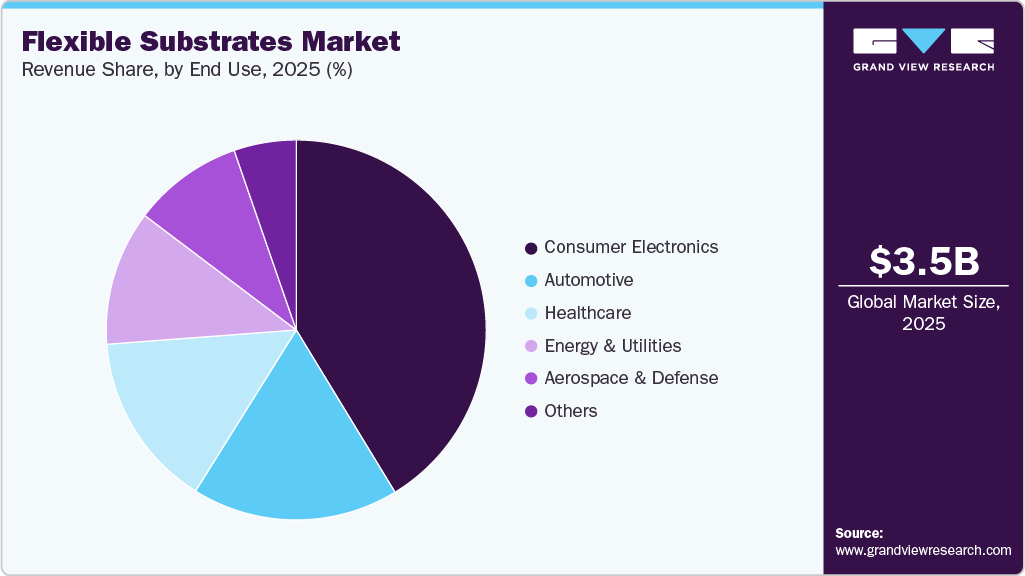
The healthcare segment is projected to grow significantly from 2026 to 2033. The growing adoption of minimally invasive and non-invasive medical technologies is contributing to market growth. Patients and healthcare providers prefer solutions that reduce discomfort and risk while maintaining high levels of diagnostic accuracy. Flexible substrates enable the creation of thin, patch-based devices and wearable sensors that can be applied directly to the skin. These devices eliminate the need for bulky equipment and invasive procedures in many cases. They also improve patient compliance, as they are easier to use and more comfortable over extended periods. This shift toward patient-friendly technologies is significantly driving the adoption of flexible substrates in healthcare.
Regional Insights
The Asia Pacific flexible substrates industry dominated with a market share of 32.9% in 2025. The expansion of wearable technology and emerging applications such as flexible solar panels and electronic textiles is contributing to market growth. Asia Pacific is witnessing increasing adoption of wearable devices for health monitoring and fitness tracking. Flexible substrates enable the development of comfortable and durable wearable products. Additionally, emerging applications such as flexible solar panels and smart fabrics are gaining traction in the region. These applications require materials that can adapt to different shapes and surfaces. As innovation continues across multiple sectors, the demand for flexible substrates is rising.

The China flexible substrates industry is projected to grow during the forecast period. The growing domestic demand for consumer electronics is a key driver in the Chinese market. China has a large and tech-savvy population that actively adopts new electronic devices and technologies. Consumers are increasingly seeking advanced features such as foldable screens, lightweight designs, and improved durability. Flexible substrates play a crucial role in enabling these features. This strong domestic demand encourages manufacturers to invest in flexible electronics and related materials. As consumer preferences continue to evolve, the market is poised for sustained growth.
North America Flexible Substrates Market Trends
The flexible substrates industry in North America is witnessing significant growth over the forecast period. The increasing focus on healthcare innovation and wearable medical devices is a key driver in the region. North America has a highly developed healthcare sector that is rapidly adopting digital and remote monitoring technologies. Flexible substrates are used in wearable medical devices that monitor vital signs and support continuous patient care. These materials enable the creation of comfortable and reliable devices that can be worn for extended periods. They also support the integration of sensors and electronics into compact and non-invasive formats. As healthcare systems emphasize preventive care and remote monitoring, the demand for flexible substrates is increasing.
U.S. Flexible Substrates Market Trends
The flexible substrates industry in the U.S. is witnessing significant growth. The expanding wearable technology and digital healthcare sectors are key drivers in the U.S. Flexible substrates are essential for wearable devices that monitor health metrics such as heart rate, physical activity, and other physiological parameters. These devices require materials that can conform to the body while maintaining performance and durability. The growing focus on preventive healthcare and remote patient monitoring is accelerating the adoption of wearable medical devices. Flexible substrates enable the development of comfortable and reliable solutions for long-term use. As digital health technologies gain traction, the demand for flexible substrates continues to rise.
Europe Flexible Substrates Market Trends
The flexible substrates industry in Europe is expected to grow during the forecast period. The strong presence of the automotive industry and the transition to electric and connected vehicles are driving market growth. Flexible substrates are widely used in automotive electronics, including curved displays, sensors, and advanced control systems. These materials help reduce weight, improve design flexibility, and enhance vehicle performance. In electric vehicles, efficient use of space and lightweight components are critical, further increasing the need for flexible substrates. They also support the integration of advanced driver assistance systems and infotainment technologies. As the automotive sector evolves, the demand for flexible substrates continues to grow.
The UK flexible substrates industry is witnessing significant growth. The expansion of smart infrastructure and connected systems across the UK is driving market growth. Flexible substrates enable compact, adaptable electronic components for smart devices and IoT applications. These materials support the integration of sensors, communication modules, and control systems into various environments. Applications include smart homes, industrial automation, and urban infrastructure projects. The ability to design electronics that fit into unconventional spaces enhances system efficiency and functionality. As the adoption of connected technologies increases, the demand for flexible substrates continues to grow.
Key Flexible Substrates Company Insights
Some of the key companies in the flexible substrate market include Avery Dennison Corporation, 3M, Millennium Circuits Limited, Ensinger, and Kolon Industries, Inc., among others. These companies are focusing on development & to gain a competitive edge in the industry. Therefore, key players are taking several strategic initiatives.
-
Nippon Electric Glass Co., Ltd. develops ultra-thin and specialty glass materials that can function as flexible or semi-flexible substrates, particularly in display and electronic device applications. The company focuses on chemically strengthened thin glass that offers higher optical clarity, thermal stability, and barrier properties than polymer-based substrates.
-
DuPont de Nemours, Inc. is a supplier in the flexible substrates market through its well-established portfolio of polyimide films and other high-performance materials used as base substrates in flexible electronics. These materials are widely utilized in flexible printed circuits, aerospace electronics, automotive systems, and industrial devices, where resistance to high temperatures, chemical stability, and mechanical flexibility are required.
-
3M Company offers flexible substrates primarily through its advanced materials and electronics segment, supplying adhesive films, dielectric materials, flexible circuits, and insulating substrates used in consumer electronics, automotive electronics, and industrial applications. Its portfolio supports flexible printed circuits (FPCs), wearable devices, and display technologies by enabling thermal management, electrical insulation, and mechanical durability in bendable formats.
Key Flexible Substrates Companies:
The following key companies have been profiled for this study on the flexible substrate market.
- 3M
- AI Technology, Inc.
- Avery Dennison Corporation
- DuPont
- Ensinger
- Kolon Industries, Inc.
- Millennium Circuits Limited
- Promex Industries
- TEKRA, LLC.
- TOYOBO CO., LTD.
Recent Developments
- In April 2024, DuPont launched the DuPont Pyralux ML Series, a new range of double-sided metal-clad laminates that expands its well-established portfolio of Pyralux materials designed for flexible and rigid-flex printed circuit boards (PCBs). These laminates form the structural foundation for complex electronic circuits across both rigid and flexible substrates. They provide essential mechanical strength and durability to flex circuits, while also enabling designers to efficiently adapt circuit layouts to fit within constrained or intricate design spaces.
Flexible Substrates Market Report Scope
Report Attribute
Details
Market size in 2025
USD 3.5 billion
Estimated market size in 2026
USD 3.9 billion
Projected market size by 2033
USD 8.2 billion
Growth rate
CAGR of 11.4% from 2026 to 2033
Actual data
2021 - 2025
Forecast period
2026 - 2033
Quantitative units
Revenue in USD million/billion and CAGR from 2026 to 2033
Report coverage
Revenue forecast, company share, competitive landscape, growth factors, and trends
Segments covered
Material, type, application, end use, region
Regional scope
North America; Europe; Asia Pacific; Latin America; MEA
Country scope
U.S.; Canada; Mexico; UK; Germany; France; China; India; Japan; Australia; South Korea; Brazil; UAE; Saudi Arabia; South Africa
Key companies profiled
3M; AI Technology, Inc.; Avery Dennison Corporation; DuPont; Ensinger; Kolon Industries, Inc.; Millennium Circuits Limited; Promex Industries; TEKRA, LLC.; TOYOBO CO., LTD.
Customization scope
Free report customization (equivalent to 8 analysts working days) with purchase. Addition or alteration to country, regional & segment scope.
Pricing and purchase options
Avail customized purchase options to meet your exact research needs. Explore purchase options
Global Flexible Substrates Market Report Segmentation
This report forecasts revenue growth at global, regional, and country levels and provides an analysis of the latest industry trends in each of the sub-segments from 2021 to 2033. For this study, Grand View Research has segmented the global flexible substrates market report based on material, type, application, end use, and region.
-
Material Outlook (Revenue, USD Billion, 2021 - 2033)
-
Plastic
-
Metal
-
Glass
-
-
Type Outlook (Revenue, USD Billion, 2021 - 2033)
-
Flexible
-
Semi-Flexible
-
Rigid
-
-
Application Outlook (Revenue, USD Billion, 2021 - 2033)
-
Flexible Displays
-
Solar Cells
-
Sensors
-
Wearable Electronics
-
Others
-
-
End Use Outlook (Revenue, USD Billion, 2021 - 2033)
-
Consumer Electronics
-
Automotive
-
Healthcare
-
Aerospace & Defense
-
Energy and Utilities
-
Others
-
-
Regional Outlook (Revenue, USD Billion, 2021 - 2033)
-
North America
-
U.S.
-
Canada
-
Mexico
-
-
Europe
-
Germany
-
UK
-
France
-
-
Asia Pacific
-
China
-
India
-
Japan
-
South Korea
-
Australia
-
-
Latin America
-
Brazil
-
-
Middle East & Africa
-
UAE
-
Saudi Arabia
-
South Africa
-
-
Frequently Asked Questions About This Report
The global flexible substrates market size was valued at USD 3.5 billion in 2025 and is estimated at USD 3.9 billion for 2026.
The global flexible substrates market is expected to grow at a CAGR of 11.4% from 2026 to 2033, reaching USD 8.2 billion by 2033.
Asia Pacific dominated with a 32.9% revenue share in 2025.
The flexible segment held the largest revenue share in 2025.
The flexible displays segment held the largest revenue share in 2025, while wearable electronics is the fastest-growing application.
Consumer electronics segment held the largest share in 2025.
The plastic segment accounted for the largest revenue share of 52.9% in 2025 in the flexible substrates market, driven by the increasing demand for flexible displays and advanced consumer electronics.
Key players include 3M; AI Technology, Inc.; Avery Dennison Corporation; DuPont; Ensinger; Kolon Industries, Inc.; Millennium Circuits Limited; Promex Industries; TEKRA, LLC.; TOYOBO CO., LTD.
Factors such as increasing demand for lightweight and flexible electronics, rising adoption of wearable devices, and growing use of flexible displays in consumer electronics play a key role in accelerating the flexible substrates market.
About the Author(s)
Display Technologies Research Team
Semiconductors & Electronics · Display TechnologiesThis report was authored by the display technologies research team at Grand View Research - comprising two research analysts, one senior research analyst, and one industry expert - with specialized expertise in the display technologies segment of the semiconductors & electronics industry. All findings are based on proprietary semiconductors & electronics databases, executive interviews, and regulatory analysis, subject to internal peer review prior to publication.
Last Updated:
Speak to Analyst


Customize this report to your needs - add regions, segments, or data points, with 20% free customization.
Or view our licence options:


ISO 9001:2015 & 27001:2022 Certified
We are GDPR and CCPA compliant! Your transaction & personal information is safe and secure. For more details, please read our privacy policy.


